L glutamate is the major excitatory neurotransmitter in the central nervous system. Glutamatergic neurotransmission is involved in most aspects of normal brain function and can be perturbed in many neuropathologic conditions. The metabotropic glutamate receptors are a family of G protein coupled receptors that have been divided into 3 groups. Group I includes GRM1 and these receptors have been shown to activate phospholipase C. GRM1 expression has been reported in various regions of the brain and spinal cord. ESTs have been isolated from brain and eye libraries.
Product Information
Format
Culture Supernatant
Control
Rat brain
Presentation
Cultured supernantant in 0.05% sodium azide.
Applications
Application
Anti-phospho-GluR1 (Ser831) Antibody, clone N453 detects level of phospho-GluR1 (Ser831) & has been published & validated for use in WB.
Key Applications
Western Blotting
Application Notes
Western Blot Analysis:
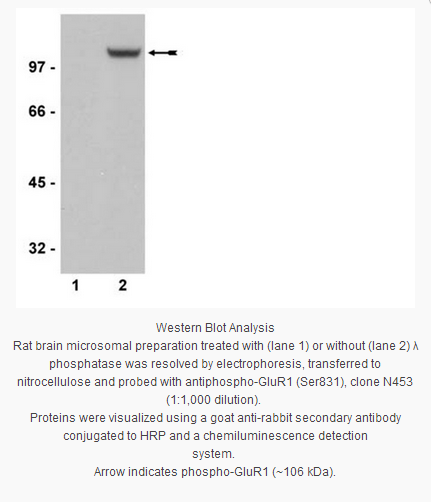
A 1:1,000-1:4,000 dilution of this lot detected phosphorylated GluR1 from a rat brain microsomal preparation (Catalog # 12-144).
Biological Information
Immunogen
KLH-conjugated, synthetic peptide containing the sequence ...QQ[pS]IN… in which pS corresponds to phospho-serine at position 831 of the GluR1 mature chain. Sequence is identical in human, rat, mouse and chicken.
Clone
N453
Host
Rabbit
Specificity
Recognizes GluR1 phosphorylated on Serine 831.
Isotype
IgG
Species Reactivity
Chicken Rat Mouse Human
Species Reactivity Note
Predicted cross-reactivity with human, mouse and chicken
Glutamate receptors are the predominant excitatory neurotransmitter receptors in the mammalian brain and are activated in a variety of normal neurophysiologic processes. These receptors are heteromeric protein complexes with multiple subunits, each possessing transmembrane regions, and all arranged to form a ligand-gated ion channel. The classification of glutamate receptors is based on their activation by different pharmacologic agonists. This gene belongs to a family of alpha-amino-3-hydroxy-5-methyl-4-isoxazole propionate (AMPA) receptors. Alternatively spliced transcript variants encoding different isoforms have been found for this gene. [provided by RefSeq]
FUNCTION:SwissProt: P42261 # Ionotropic glutamate receptor. L-glutamate acts as an excitatory neurotransmitter at many synapses in the central nervous system. Binding of the excitatory neurotransmitter L- glutamate induces a conformation change, leading to the opening of the cation channel, and thereby converts the chemical signal to an electrical impulse. The receptor then desensitizes rapidly and enters a transient inactive state, characterized by the presence of bound agonist. SIZE:906 amino acids; 101506 Da SUBUNIT:Homotetramer or heterotetramer of pore-forming glutamate receptor subunits. Tetramers may be formed by the dimerization of dimers. Interacts with DLG1 via its C-terminus. Interacts with CACNG2 and RASGRF2 (By similarity). SUBCELLULAR LOCATION:Cell membrane; Multi-pass membrane protein. Endoplasmic reticulum membrane; Multi-pass membrane protein (By similarity). Note=Interaction with CACNG2 promotes cell surface expression (By similarity). TISSUE SPECIFICITY:Widely expressed in brain. PTM:Palmitoylated. Depalmitoylated upon glutamate stimulation. Cys-603 palmitoylation leads to Golgi retention and decreased cell surface expression. In contrast, Cys-829 palmitoylation does not affect cell surface expression but regulates stimulation-dependent endocytosis (By similarity). SIMILARITY:SwissProt: P42261 ## Belongs to the glutamate-gated ion channel (TC 1.A.10) family. MISCELLANEOUS:The postsynaptic actions of Glu are mediated by a variety of receptors that are named according to their selective agonists. This receptor binds AMPA (quisqualate) > glutamate > kainate.
Product Usage Statements
Quality Assurance
routinely evaluated by western blot
Usage Statement
Unless otherwise stated in our catalog or other company documentation accompanying the product(s), our products are intended for research use only and are not to be used for any other purpose, which includes but is not limited to, unauthorized commercial uses, in vitro diagnostic uses, ex vivo or in vivo therapeutic uses or any type of consumption or application to humans or animals.
Storage and Shipping Information
Storage Conditions
Stable for 1 year at -20°C from date of receipt.
For maximum recovery of product, centrifuge the vial prior to removing the cap.
L glutamate is the major excitatory neurotransmitter in the central nervous system. Glutamatergic neurotransmission is involved in most aspects of normal brain function and can be perturbed in many neuropathologic conditions. The metabotropic glutamate receptors are a family of G protein coupled receptors that have been divided into 3 groups. Group I includes GRM1 and these receptors have been shown to activate phospholipase C. GRM1 expression has been reported in various regions of the brain and spinal cord. ESTs have been isolated from brain and eye libraries.
Product Information
Format
Culture Supernatant
Control
Rat brain
Presentation
Cultured supernantant in 0.05% sodium azide.
Applications
Application
Anti-phospho-GluR1 (Ser831) Antibody, clone N453 detects level of phospho-GluR1 (Ser831) & has been published & validated for use in WB.
Key Applications
Western Blotting
Application Notes
Western Blot Analysis:
A 1:1,000-1:4,000 dilution of this lot detected phosphorylated GluR1 from a rat brain microsomal preparation (Catalog # 12-144).
Biological Information
Immunogen
KLH-conjugated, synthetic peptide containing the sequence ...QQ[pS]IN… in which pS corresponds to phospho-serine at position 831 of the GluR1 mature chain. Sequence is identical in human, rat, mouse and chicken.
Clone
N453
Host
Rabbit
Specificity
Recognizes GluR1 phosphorylated on Serine 831.
Isotype
IgG
Species Reactivity
Chicken Rat Mouse Human
Species Reactivity Note
Predicted cross-reactivity with human, mouse and chicken
Glutamate receptors are the predominant excitatory neurotransmitter receptors in the mammalian brain and are activated in a variety of normal neurophysiologic processes. These receptors are heteromeric protein complexes with multiple subunits, each possessing transmembrane regions, and all arranged to form a ligand-gated ion channel. The classification of glutamate receptors is based on their activation by different pharmacologic agonists. This gene belongs to a family of alpha-amino-3-hydroxy-5-methyl-4-isoxazole propionate (AMPA) receptors. Alternatively spliced transcript variants encoding different isoforms have been found for this gene. [provided by RefSeq]
FUNCTION:SwissProt: P42261 # Ionotropic glutamate receptor. L-glutamate acts as an excitatory neurotransmitter at many synapses in the central nervous system. Binding of the excitatory neurotransmitter L- glutamate induces a conformation change, leading to the opening of the cation channel, and thereby converts the chemical signal to an electrical impulse. The receptor then desensitizes rapidly and enters a transient inactive state, characterized by the presence of bound agonist. SIZE:906 amino acids; 101506 Da SUBUNIT:Homotetramer or heterotetramer of pore-forming glutamate receptor subunits. Tetramers may be formed by the dimerization of dimers. Interacts with DLG1 via its C-terminus. Interacts with CACNG2 and RASGRF2 (By similarity). SUBCELLULAR LOCATION:Cell membrane; Multi-pass membrane protein. Endoplasmic reticulum membrane; Multi-pass membrane protein (By similarity). Note=Interaction with CACNG2 promotes cell surface expression (By similarity). TISSUE SPECIFICITY:Widely expressed in brain. PTM:Palmitoylated. Depalmitoylated upon glutamate stimulation. Cys-603 palmitoylation leads to Golgi retention and decreased cell surface expression. In contrast, Cys-829 palmitoylation does not affect cell surface expression but regulates stimulation-dependent endocytosis (By similarity). SIMILARITY:SwissProt: P42261 ## Belongs to the glutamate-gated ion channel (TC 1.A.10) family. MISCELLANEOUS:The postsynaptic actions of Glu are mediated by a variety of receptors that are named according to their selective agonists. This receptor binds AMPA (quisqualate) > glutamate > kainate.
Product Usage Statements
Quality Assurance
routinely evaluated by western blot
Usage Statement
Unless otherwise stated in our catalog or other company documentation accompanying the product(s), our products are intended for research use only and are not to be used for any other purpose, which includes but is not limited to, unauthorized commercial uses, in vitro diagnostic uses, ex vivo or in vivo therapeutic uses or any type of consumption or application to humans or animals.
Storage and Shipping Information
Storage Conditions
Stable for 1 year at -20°C from date of receipt.
For maximum recovery of product, centrifuge the vial prior to removing the cap.








 京公网安备11010802025653 版权所有:北京逸优科技有限公司