MEK1/2, also known as MAP2K1, are mitogen activated protein kinases and are involved in cell growth and differentiation. MEK is activated by a variety of growth factors and cytokines resulting in phosphorylation at Ser217/218 and Ser221/222. Diseases associated with MEK1/2 is cardio-facio- cutaneous syndrome (CFC), which is an autosomal dominant trait.
Product Information
Format
Unpurified
Control
Untreated and EGF-treated serum-starved A431 cell lysate
Presentation
Rabbit Monoclonal in buffer containing 50 mM Tris-Glycine (pH 7.4), 0.15 M NaCl containing 40% Glycerol, 0.01% sodium azide and 0.05% BSA.
Applications
Application
Please note that this product will not be available for sale after March 15, 2015. Please select one of the other antibodies against this target.
Key Applications
Immunoprecipitation
Western Blotting
Immunocytochemistry
Immunohistochemistry (Paraffin)
Application Notes
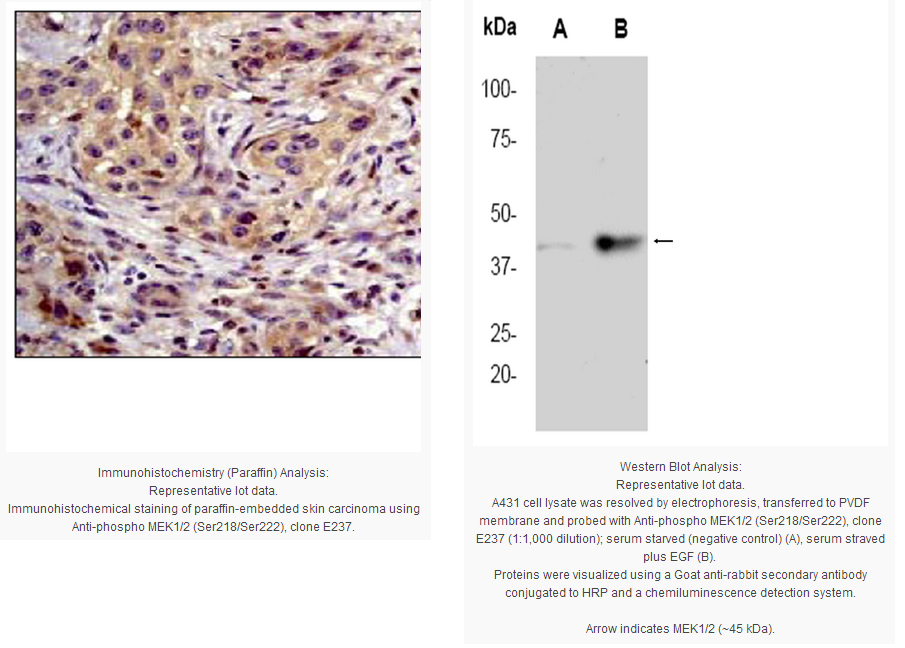
Immunohistochemistry Analysis: A 1:50-100 dilution from a previous lot detected MEK1/2 in skin carcinoma tissue.
Immunocytochemistry Analysis: A 1:50-100 dilution from a previous lot was used in IC.
Immunoprecipitation Analysis: A 1:30 dilution from a previous lot was used in IP.
Biological Information
Immunogen
Phospho-synthetic peptide corresponding to residues surrounding Ser218 and Ser222 of human MEK1/2.
Epitope
Phosphorylated Ser218/Ser222
Clone
E237
Host
Rabbit
Specificity
The antibody only detects MEK1/2 phosphorylated on Ser218 and Ser222.
FUNCTION:Catalyzes the concomitant phosphorylation of a threonine and a tyrosine residue in a Thr-Glu-Tyr sequence located in MAP kinases. Activates ERK1 and ERK2 MAP kinases. CATALYTIC ACTIVITY:ATP + a protein = ADP + a phosphoprotein. ENZYME REGULATION:Activated by phosphorylation. SUBUNIT STRUCTURE:Interacts with MORG1 By similarity. Interacts with Yersinia yopJ. PTM:Phosphorylation on Ser/Thr by MAP kinase kinase kinases (RAF or MEKK1) regulates positively the kinase activity.
Acetylation by Yersinia yopJ prevents phosphorylation and activation, thus blocking the MAPK signaling pathway. INVOLVEMENT IN DISEASE:Defects in MAP2K1 are a cause of cardiofaciocutaneous syndrome (CFC syndrome) [MIM:115150]; also known as cardio-facio-cutaneous syndrome. CFC syndrome is characterized by a distinctive facial appearance, heart defects and mental retardation. Heart defects include pulmonic stenosis, atrial septal defects and hypertrophic cardiomyopathy. Some affected individuals present with ectodermal abnormalities such as sparse, friable hair, hyperkeratotic skin lesions and a generalized ichthyosis-like condition. Typical facial features are similar to Noonan syndrome. They include high forehead with bitemporal constriction, hypoplastic supraorbital ridges, downslanting palpebral fissures, a depressed nasal bridge, and posteriorly angulated ears with prominent helices. The inheritance of CFC syndrome is autosomal dominant. SEQUENCE SIMILARITIES:Belongs to the protein kinase superfamily. STE Ser/Thr protein kinase family. MAP kinase kinase subfamily.
Contains 1 protein kinase domain.
Product Usage Statements
Quality Assurance
Evaluated by Western Blot in untreated and EGF-treated serum-starved A431 cell lysates.
Western Blot Analysis: A 1:500-1,000 dilution of this antibody was used to detect MEK1/2 in untreated and EGF-treated serum-starved A431 cell lysate.
Usage Statement
Unless otherwise stated in our catalog or other company documentation accompanying the product(s), our products are intended for research use only and are not to be used for any other purpose, which includes but is not limited to, unauthorized commercial uses, in vitro diagnostic uses, ex vivo or in vivo therapeutic uses or any type of consumption or application to humans or animals.
Storage and Shipping Information
Storage Conditions
Stable for 1 year at -20ºC from date of receipt. Handling Recommendations: Upon first thaw, and prior to removing the cap, centrifuge the vial and gently mix the solution. Aliquot into microcentrifuge tubes and store at -20°C. Avoid repeated freeze/thaw cycles, which may damage IgG and affect product performance. Note: Variability in freezer temperatures below -20°C may cause glycerol containing solutions to become frozen during storage.
MEK1/2, also known as MAP2K1, are mitogen activated protein kinases and are involved in cell growth and differentiation. MEK is activated by a variety of growth factors and cytokines resulting in phosphorylation at Ser217/218 and Ser221/222. Diseases associated with MEK1/2 is cardio-facio- cutaneous syndrome (CFC), which is an autosomal dominant trait.
Product Information
Format
Unpurified
Control
Untreated and EGF-treated serum-starved A431 cell lysate
Presentation
Rabbit Monoclonal in buffer containing 50 mM Tris-Glycine (pH 7.4), 0.15 M NaCl containing 40% Glycerol, 0.01% sodium azide and 0.05% BSA.
Applications
Application
Please note that this product will not be available for sale after March 15, 2015. Please select one of the other antibodies against this target.
Key Applications
Immunoprecipitation
Western Blotting
Immunocytochemistry
Immunohistochemistry (Paraffin)
Application Notes
Immunohistochemistry Analysis: A 1:50-100 dilution from a previous lot detected MEK1/2 in skin carcinoma tissue.
Immunocytochemistry Analysis: A 1:50-100 dilution from a previous lot was used in IC.
Immunoprecipitation Analysis: A 1:30 dilution from a previous lot was used in IP.
Biological Information
Immunogen
Phospho-synthetic peptide corresponding to residues surrounding Ser218 and Ser222 of human MEK1/2.
Epitope
Phosphorylated Ser218/Ser222
Clone
E237
Host
Rabbit
Specificity
The antibody only detects MEK1/2 phosphorylated on Ser218 and Ser222.
FUNCTION:Catalyzes the concomitant phosphorylation of a threonine and a tyrosine residue in a Thr-Glu-Tyr sequence located in MAP kinases. Activates ERK1 and ERK2 MAP kinases. CATALYTIC ACTIVITY:ATP + a protein = ADP + a phosphoprotein. ENZYME REGULATION:Activated by phosphorylation. SUBUNIT STRUCTURE:Interacts with MORG1 By similarity. Interacts with Yersinia yopJ. PTM:Phosphorylation on Ser/Thr by MAP kinase kinase kinases (RAF or MEKK1) regulates positively the kinase activity.
Acetylation by Yersinia yopJ prevents phosphorylation and activation, thus blocking the MAPK signaling pathway. INVOLVEMENT IN DISEASE:Defects in MAP2K1 are a cause of cardiofaciocutaneous syndrome (CFC syndrome) [MIM:115150]; also known as cardio-facio-cutaneous syndrome. CFC syndrome is characterized by a distinctive facial appearance, heart defects and mental retardation. Heart defects include pulmonic stenosis, atrial septal defects and hypertrophic cardiomyopathy. Some affected individuals present with ectodermal abnormalities such as sparse, friable hair, hyperkeratotic skin lesions and a generalized ichthyosis-like condition. Typical facial features are similar to Noonan syndrome. They include high forehead with bitemporal constriction, hypoplastic supraorbital ridges, downslanting palpebral fissures, a depressed nasal bridge, and posteriorly angulated ears with prominent helices. The inheritance of CFC syndrome is autosomal dominant. SEQUENCE SIMILARITIES:Belongs to the protein kinase superfamily. STE Ser/Thr protein kinase family. MAP kinase kinase subfamily.
Contains 1 protein kinase domain.
Product Usage Statements
Quality Assurance
Evaluated by Western Blot in untreated and EGF-treated serum-starved A431 cell lysates.
Western Blot Analysis: A 1:500-1,000 dilution of this antibody was used to detect MEK1/2 in untreated and EGF-treated serum-starved A431 cell lysate.
Usage Statement
Unless otherwise stated in our catalog or other company documentation accompanying the product(s), our products are intended for research use only and are not to be used for any other purpose, which includes but is not limited to, unauthorized commercial uses, in vitro diagnostic uses, ex vivo or in vivo therapeutic uses or any type of consumption or application to humans or animals.
Storage and Shipping Information
Storage Conditions
Stable for 1 year at -20ºC from date of receipt. Handling Recommendations: Upon first thaw, and prior to removing the cap, centrifuge the vial and gently mix the solution. Aliquot into microcentrifuge tubes and store at -20°C. Avoid repeated freeze/thaw cycles, which may damage IgG and affect product performance. Note: Variability in freezer temperatures below -20°C may cause glycerol containing solutions to become frozen during storage.








 京公网安备11010802025653 版权所有:北京逸优科技有限公司