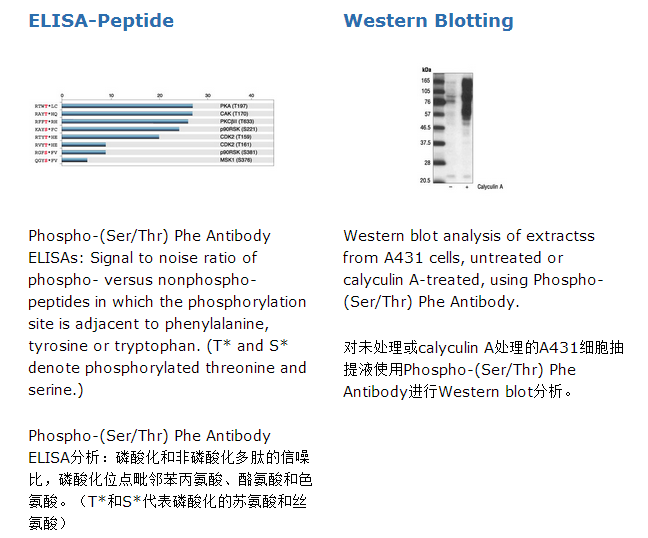
Phospho-(Ser/Thr) Phe Antibody detects phospho-serine or threonine in the context of tyrosine, tryptophan or phenylalanine at the -1 position or phenylalanine at the +1 position. The antibody does not cross-react with the nonphosphorylated form of these motifs, nor does it cross-react with other phospho-serine/threonine-containing proteins and peptides. (U.S. Patent No's.: 6,441,140; 6,982,318; 7,259,022; 7,344,714; U.S.S.N. 11,484,485; and all foreign equivalents.)
Source / Purification
Polyclonal antibodies are produced by immunizing animals with a synthetic phospho-serine/threonine-phenylalanine-containing peptide. Antibodies are purified by protein A and peptide affinity chromatography.
Background
A hallmark of signal transduction pathways is the reversible phosphorylation of serine and threonine residues within specific sequences, or motifs, in target proteins. Specific signaling motifs include not only sequences that are recognized by protein kinases (1), but also those that are recognized by phosphorylation-dependent binding proteins such as 14-3-3 (2). These modular phosphoprotein interacting domains are critical elements in modulating, directing and amplifying intracellular communications. CST has pioneered the development of phospho-motif specific antibodies, which are invaluable tools for probing the complexity of phospho-regulatory pathways.Many critical protein kinases can be regulated by phosphorylation at a specific serine or threonine surrounded by phenylalanine or tyrosine. For example, Akt, a kinase that regulates cell survival, is activated by phosphorylation at Ser473, a site surrounded by phenylalanine and tyrosine (3). RSK1, p70S6K, and certain PKC isoforms also contain a similar consensus phosphorylation site. Phosphorylation of these sites is required for kinase activity (4,5). The Phospho-(Ser/Thr) Phe Antibody is a powerful tool for discovery of new proteins containing this important regulatory motif.








 京公网安备11010802025653 版权所有:北京逸优科技有限公司