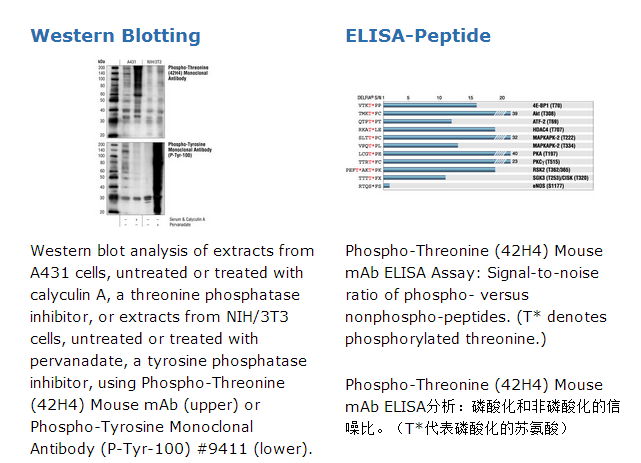
Phospho-Threonine (42H4) Mouse mAb binds phosphorylated threonine residues in a manner largely independent of the surrounding amino acid sequence. The antibody is phospho-specific but does not cross-react with phospho-tyrosine-containing sequences. It does show slight cross-reactivity with a few phospho-serine-containing peptides. By ELISA, it recognizes a wide variety of threonine-phosphorylated peptides. (U.S. Patent No's.: 6,441,140; 6,982,318; 7,259,022; 7,344,714; U.S.S.N. 11,484,485; and all foreign equivalents.)
Source / Purification
Monoclonal antibody is produced by immunizing animals with phospho-Thr-containing peptides.
Background
Much of the dynamic behavior of cellular proteins, including the regulation of molecular interactions (1), subcellular localization (2), and transcriptional regulation (3) is controlled by a variety of post-translational modifications (4). Antibodies specific for these post-translational modifications are invaluable tools in the quest to understand normal and pathogenic molecular and cellular behavior. General protein modification antibodies are designed to react with modified amino acid residues (e.g., phospho-threonine, phospho-tyrosine, acetyl-lysine, nitro-tyrosine) independently of the sequence in which they are embedded. This ability to recognize modified residues in a "context independent" fashion gives these antibodies broad reactivities, presumably conferring upon them the ability to react with hundreds of distinct proteins. This broad pattern of reactivity makes these antibodies especially valuable in multiplex analyses and target discovery programs.Protein kinases are among the most abundant eukaryotic regulatory proteins; over 500 separate kinase genes are encoded in mammalian genomes (5,6). In spite of the importance of kinases in eukaryotic biology, relatively few of their physiological targets are known. Phospho-Threonine Antibody (P-Thr-Polyclonal) #9381 and Phospho-Threonine (42H4) Monoclonal Antibody #9386 provide powerful tools for discovering targets of serine/threonine kinases, for monitoring and characterizing in vitro threonine phosphorylation reactions as well as for high throughput Ser/Thr kinase drug discovery.








 京公网安备11010802025653 版权所有:北京逸优科技有限公司