Species predicted to react based on 100% sequence homology:Monkey
Specificity / Sensitivity
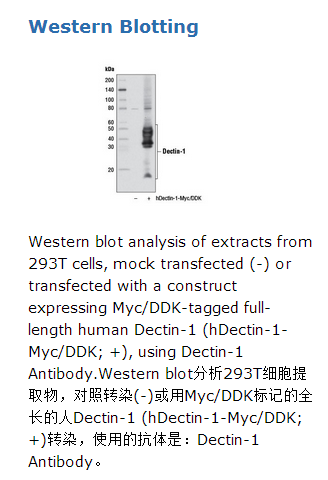
Dectin-1 Antibody recognizes endogenous levels of total Dectin-1 protein. This antibody cross-reacts with an 80 kDa protein of unknown origin. Alternative splicing of the Dectin-1 transcript can lead to eight isoforms with predicted molecular weights ranging from 5-27 kDa. Glycosylation causes Dectin-1 to run higher than its predicted molecular weight.
Source / Purification
Polyclonal antibodies are produced by immunizing animals with a synthetic peptide corresponding to residues near the amino terminus of human Dectin-1 protein. Antibodies are purified by protein A and peptide affinity chromatography.
Background
Dectin-1 is a C-type lectin receptor expressed by macrophages, monocytes, dendrtic cells, neutrophils, and a subset of γδ T cells (1,2). Dectin-1 is a glycoprotein with eight different isoforms, generated through alternative splicing (3-5). It plays an important role in anti-fungal immunity by acting as a pattern recognition receptor for β-glucans found on the cell wall of fungi and some bacteria (5,6). Dectin-1 is composed of a short amino-terminal cytoplasmic domain containing an ITAM-like motif, a transmembrane domain, and an extracellular carboxy-terminal C-type lectin domain (5). Dectin-1 recognizes β-glucans through its C-type lectin domain and transduces signals through its ITAM-like motif by recruiting and activating Syk (7,8). Dendritic cells activated through Dectin-1 promote differentiation of Th17 cells by producing IL-6 and IL-23 (9).








 京公网安备11010802025653 版权所有:北京逸优科技有限公司