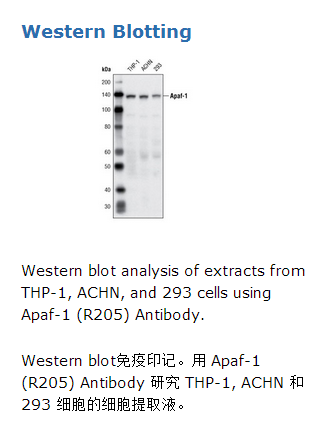
Apaf-1 (R205) Antibody detects endogenous levels of total Apaf-1 protein.
Source / Purification
Polyclonal antibodies are prepared by immunizing animals with a synthetic peptide corresponding to residues surrounding Arg205 of human Apaf-1 protein. Antibodies were purified by protein A and peptide affinity chromatography.
Background
Apoptotic protease activating factor 1 (Apaf-1), originally identified as the mammalian homolog of the C. elegans apoptotic regulatory protein CED-4, is an important signaling protein involved in the activation of caspase-9 during apoptosis (1). Cytosolic Apaf-1 forms a complex with caspase-9 in the presence of cytochrome c and dATP, ultimately leading to caspase-9 activation and subsequent activation of caspase-3 (2,3). The protein contains an amino-terminal CARD domain, a central CED-4 homology domain, and multiple WD-40 repeats at the carboxy-terminus. Several isoforms of Apaf-1 are expressed through alternative splicing generating a small insert following the CARD domain as well as an extra WD-40 repeat (4). Apaf-1 knock-out mice display widespread defects in apoptosis and resistance to a variety of apoptotic stimuli (5,6).








 京公网安备11010802025653 版权所有:北京逸优科技有限公司