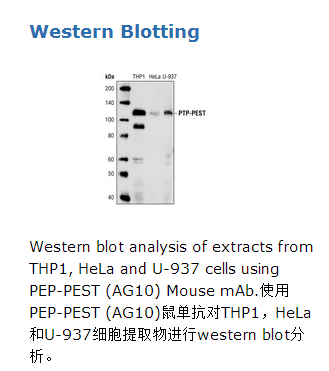
PTP-PEST (AG10) Mouse mAb detects endogenous levels of total PTP-PEST protein. This antibody does not cross-react with other protein tyrosine pho sphatases.
Source / Purification
Monoclonal antibody is produced by immunizing animals with human PTP-PEST recombinant protein. The antibody recognizes an epitope within the amino-terminal 305 residues.
Background
PTP-PEST is a ubiquitously expressed cytosolic protein tyrosine phosphatase with multiple proline-rich regions that appear to be the the docking sites for PTP-PEST binding partners or substrates (1). PTP-PEST regulates fibroblast adhesion, migration and cytokinesis through its association with and dephosphorylation of p130 Cas, paxillin, PSTPIP1, WASp, and other adhesion molecules (1-5). By modulating phosphorylation states of Shc, Pyk2, Fak and WASp, PTP-PEST negatively regulates of lymphocyte activation (1,6). In mammary epithelial cells, EGF facilitates the dephosphorylation of Jak2 by PTP-PEST, thereby interfering with lactogenic hormone PRL signaling (7). PTP-PEST dephosphorylates c-Abl as well, which affects the phosphorylation states of PTP-PEST substates such as paxillin, p130 Cas, Crk and PSTPIP1 (8).








 京公网安备11010802025653 版权所有:北京逸优科技有限公司