RACK1 Antibody识别内源性RACK1总蛋白。通过人工合成人源RACK1蛋白相应的多肽片段去免疫动物从而制备出多克隆抗体。通过蛋白A和多肽亲和层析纯化抗体。高度保守receptor for activated C kinase 1 (RACK1)与异源三聚体βG蛋白的β亚基同源,该蛋白起初通过它与活化的PKCβII和其它传统的PKC亚基的结合被鉴定(1)。RACK1蛋白是一个支架蛋白,它能招募PKC和大范围的特异亚细胞定位的其它蛋白质,从而促进多种蛋白质复合物的形成去诱导和整合不同信号通路(2)。该蛋白的一个例子是PKC依赖的JNK激活的提高(3)。RACK1蛋白也停留在真核核糖体,认为 RACK1蛋白参与信号复合物的装配,该复合物也可调节翻译(4)。RACK1蛋白结合到Src蛋白的SH2区域,并且在PKC激活后,通过Src蛋白使RACK1蛋白在Tyr228位点发生磷酸化(5)。
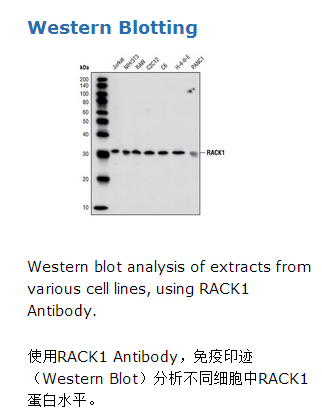
RACK1 Antibody recognizes endogenous levels of total RACK1 protein.
Source / Purification
Polyclonal antibodies are produced by immunizing animals with a synthetic peptide corresponding to human RACK1. Antibodies are purified by protein A and peptide affinity chromatography.
Background
The highly conserved receptor for activated C kinase 1 (RACK1), homologous to the β subunit of heterotrimeric G-proteins, was originally identified through its binding of active PKCβII and other classical PKC isoforms (1). RACK1 is a scaffold protein that recruits PKC and a wide range of other proteins to specific subcellular locations, promoting the formation of multiprotein complexes to induce and integrate various signaling pathways (reviewed in 2). One example of this is its enhancement of PKC-dependent JNK activation (3). RACK1 protein also resides in the eukaryotic ribosome, suggesting the possibility that RACK1 participates in the assembly of signaling complexes that regulate translation as well (reviewed in 4). RACK1 binds the SH2 domain of Src, and phosphorylation of RACK1 by Src occurs at Tyr228 after PKC activation (5).







 京公网安备11010802025653 版权所有:北京逸优科技有限公司