Species predicted to react based on 100% sequence homology:Monkey, Bovine, Horse
Specificity / Sensitivity
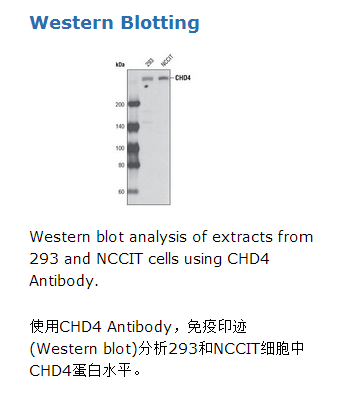
CHD4 Antibody detects endogenous levels of total CHD4 protein.
Source / Purification
Polyclonal antibodies are produced by immunizing animals with a synthetic peptide corresponding to human CHD4 protein. Antibodies are purified by protein A and peptide affinity chromatography.
Background
Chromodomain-helicase-DNA-binding domain (CHD) proteins have been identified in a variety of organisms (1,2). This family of nine proteins is divided into three separate subfamilies: subfamily I (CHD1 and CHD2), subfamily II (CHD3 and CHD4), and subfamily III (CHD5, CHD6, CHD7, CHD8, CHD9). All CHD proteins contain two tandem amino-terminal chromodomains, a SWI/SNF-related ATPase domain, and a carboxy-terminal DNA binding domain (1,2). The chromodomains facilitate binding to methylated lysine residues of histone proteins and confer interactions with specific regions of chromatin. The SWI/SNF-related ATPase domain utilizes energy from ATP hydrolysis to modify chromatin structure. CHD proteins are often found in large, multi-protein complexes, with their transcriptional activation or repression activity governed by other proteins also found in the complex. CHD3 (also known as Mi2-α) and CHD4 (also known as Mi2-β) are central components of the nucleosome remodeling and histone deacetylase (NuRD) transcriptional repressor complex, which also contains HDAC1, HDAC2, RbAp48, RbAp46, MTA1, MTA2, MTA3, and MBD3 (3-8). Both CHD3 and CHD4 contain two PHD (plant homeodomain) zinc finger domains that bind directly to HDAC1 and HDAC2.








 京公网安备11010802025653 版权所有:北京逸优科技有限公司