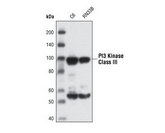
PI3 Kinase Class III抗体检测内源性的PI3K class III总蛋白的含量。该抗体可能会与一种未知的55 kDa左右的蛋白发生交叉反应。多克隆抗体是采用与人类PI3K class III周围相对应的合成肽段免疫动物生产的。多克隆抗体采用肽亲和色谱法纯化。3种不同类型的3-磷酸肌醇激酶(PI3K)已近被鉴别。和其他的PI3Ks不同,PI3K class III 能够催化磷脂酰肌醇 在D3位点的磷酸化,产生3-磷酸磷脂酰肌醇(PI(3)P) (1)。 PI3K class III 是Vps34,的哺乳动物同系物,最先是在酵母中发现。 PI3K class III 能够和调节性亚基p150相互作用,而p150是Vps15的哺乳动物同系物,能够通过十四(烷)酰化调节细胞膜的活动(2,3)。 PI3K class III能够通过FYVE 或者PX基团招募不同的蛋白到细胞膜上,从而调节膜泡运输和蛋白分选(4))。更主要的是, PI3K class III 能够调节细胞的自我吞噬, trimeric G蛋白的信号传导和mTOR营养敏感通路(5)。
PI3 Kinase Class III Antibody detects endogenous levels of total PI3K class III protein. This antibody may cross-react with an unidentified protein at ~55 kDa.
Source / Purification
Polyclonal antibodies are produced by immunizing animals with a synthetic peptide corresponding to human PI3K class III. Antibodies are purified peptide affinity chromatography.
Background
Three distinct types of phosphoinositide 3-kinases (PI3K) have been characterized. Unlike other PI3Ks, PI3K class III catalyzes the phosphorylation of phosphatidylinositol at the D3 position, producing phosphatidylinositol-3-phosphate (PIP3) (1). PI3K class III is the mammalian homolog of Vps34, first identified in yeast. PI3K class III interacts with the regular subunit p150, the mammalian homolog of Vps15, which regulates cellular membrane association through myristoylation (2,3). PIP3 recruits several proteins with FYVE or PX domains to membranes regulating vesicular transport and protein sorting (4). Moreover, PI3K class III has been shown to regulate autophagy, trimeric G-protein signaling, and the mTOR nutrient-sensing pathway (5).








 京公网安备11010802025653 版权所有:北京逸优科技有限公司