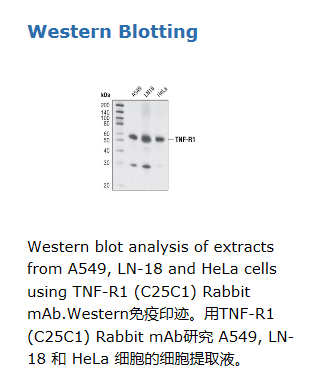




TNF-R1 (C25C1) Rabbit mAb detects endogenous levels of human TNF-R1 protein. This antibody does not appear to cross-react with other related family members.
Source / Purification
Monoclonal antibody is produced by immunizing animals with a synthetic peptide corresponding to residues within the intracellular region and surrounding Ser331 of human TNF-R1 protein.
Background
TNF-α is an important cytokine produced by numerous cell types including neutrophils, activated lymphoctyes, macrophages an NK cells. It plays a critical role in inflammatory responses and in apoptosis (1). TNF-α exists as a membrane-anchored and soluble form, both of which show biological activity. Response to TNF-α is mediated through two receptors, TNF-R1, which is widely expressed, and TNF-R2, which is expressed mainly in immune and endothelial cells (2). Antagonists to TNF-α have been validated as therapeutic targets for rheumatoid arthritis and other immune disorders (3).
The two receptors for TNF-α, TNF-R1 (55 kDa) and TNF-R2 (75 kDa) can mediate distinct cellular responses (4,5). In most cases cytotoxicity elicited by TNF has been reported to act through TNF-R1 (6,7). Cytotoxicity is mediated by a "death domain" with the intracellular region of the receptor that binds to the death domain adaptor protein TRADD and triggers the activation of caspases (8). Soluble forms of both receptors have also been characterized which can bind TNF-α and may play an important role in immune disorders (9,10).
Storage:Supplied in 10 mM sodium HEPES (pH 7.5), 150 mM NaCl, 100 µg/ml BSA, 50% glycerol and less than 0.02% sodium azide. Store at –20°C. Do not aliquot the antibody.