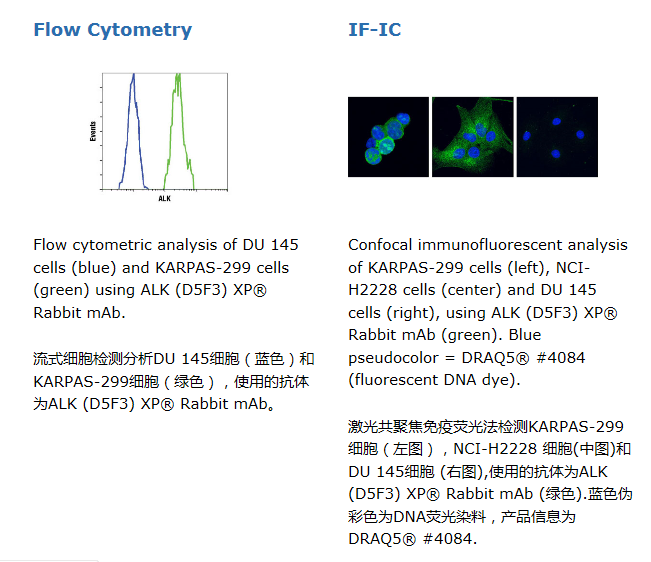




ALK (D5F3) XP® Rabbit mAb detects endogenous levels of total ALK protein as well as ALK fusion proteins, such as EML4-ALK variants and NPM-ALK, even at low levels. This antibody does not cross-react with other family members.
Source / Purification
Monoclonal antibody is produced by immunizing animals with recombinant protein corresponding to residues in the carboxy terminus of human ALK.
Background
Anaplastic lymphoma kinase (ALK) is a tyrosine kinase receptor for pleiotrophin (PTN), a growth factor involved in embryonic brain development (1-3). In ALK-expressing cells, PTN induces phosphorylation of both ALK and the downstream effectors IRS-1, Shc, PLCγ, and PI3 kinase (1). ALK was originally discovered as a nucleophosmin (NPM)-ALK fusion protein produced by a translocation (4). Investigators have found that the NPM-ALK fusion protein is a constitutively active, oncogenic tyrosine kinase associated with anaplastic lymphoma (4). Research literature suggests that activation of PLCγ by NPM-ALK may be a crucial step for its mitogenic activity and involved in the pathogenesis of anaplastic lymphomas (5). A distinct ALK oncogenic fusion protein involving ALK and echinoderm microtubule-associated protein like 4 (EML4) has been described in the research literature from a non-small cell lung cancer (NSCLC) cell line, with corresponding fusion transcripts present in some cases of lung adenocarcinoma. The short, amino-terminal region of the microtubule-associated protein EML4 is fused to the kinase domain of ALK (6-8).
Investigators have identified ALK translocations with other fusion partners, such as TRK-fused gene (TFG) and KIF5B, which have also been associated with NSCLC (6,7). In particular, the EML4-ALK fusion protein has been found in 3-7% of NSCLC samples (6-14).
Storage:Supplied in 10 mM sodium HEPES (pH 7.5), 150 mM NaCl, 100 µg/ml BSA, 50% glycerol and less than 0.02% sodium azide. Store at –20°C. Do not aliquot the antibody.