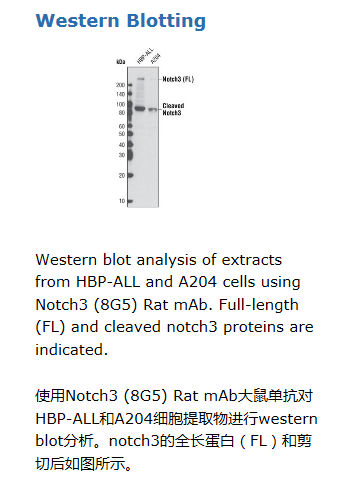




Notch3 (8G5) Rat mAb detects endogenous levels of total notch3 protein. It recognizes the full-length (270 kDa) and the extracellular truncated fragment containing a short extracellular region, the transmembrane domain and the intracellular region (90 kDa).
Source / Purification
Monoclonal antibody is produced by immunizing animals with a fusion protein corresponding to intracellular residues of notch3.
Background
Notch1 is a transmembrane protein functioning in development and the determination of cell fate (1). During maturation, the notch molecule is cleaved by a furin-like convertase at its extracellular domain (2). Upon binding to a ligand such as Delta1, or upon extracellular calcium depletion, the carboxy-terminal notch1 fragment is released and further cleaved between Gly1743 and Val1744 (3,4). The resulting activated cytosolic fragment translocates to the nucleus where it activates transcription.
Notch3 is a member of notch family that is processed in a similar way to notch1 (5). It is expressed primarily in arterial smooth muscle cells (SMC). Mutations altering the number of cysteine residues in the notch3 extracellular region are associated with cerebral autosomal dominant arteriopathy with subcortical infarcts and leukoencephalopathy (CADASIL), a hereditary angiopathy leading to strokes and dementia in adults (6-8). Recent studies indicate that notch3 is overexpressed in many types of cancers (9-11).
Storage:Supplied in 10 mM sodium HEPES (pH 7.5), 150 mM NaCl, 100 µg/ml BSA, 50% glycerol and less than 0.02% sodium azide. Store at –20°C. Do not aliquot the antibody.