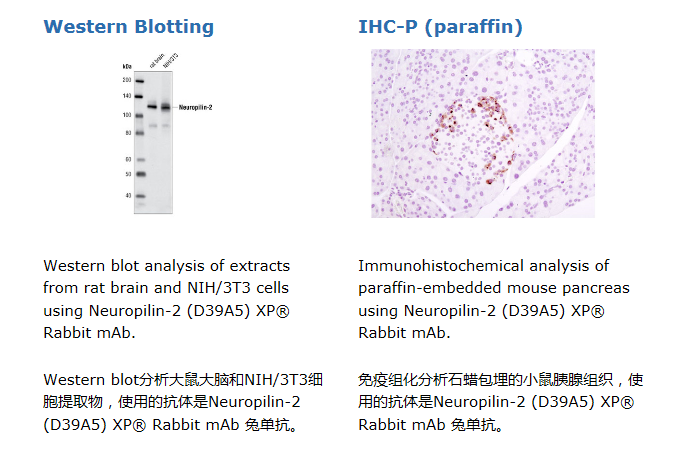




Neuropilin-2 (D39A5) XP® Rabbit mAb detects endogenous levels of total neuropilin-2 protein.
Source / Purification
Monoclonal antibody is produced by immunizing animals with recombinant protein specific to the amino terminus of mouse Neuropilin-2 protein.
Background
Class 3 secreted semaphorin (Sema3A) is a chemorepellent that acts upon a wide variety of axons. As such, it induces a dramatic redistribution and depolymerization of actin filaments that results in growth cone collapse. Plexins are single pass, transmembrane signaling proteins encompassing Plexin A1, A2, A3 and A4. Plexins form a complex with neuropilin-1 and -2 and the cell adhesion protein L1 to form a functional semaphorin receptor (1,2). The GTPase Rnd1 binds to the cytoplasmic domain of Plexin A1 to trigger cytoskeletal collapse. In contrast, the GTPase RhoD blocks Rnd1-mediated Plexin A1 activation and repulsion of sympathetic axons by Sema3A (3).Neuropilin-2, a single pass, transmembrane glycoprotein, can also bind to VEGF165 and VEGF145, but not VEGF121. Thus, in addition to neuronal guidance, neuropilin-2 plays a role in angiogenesis and cardiovascular functions (4). Although neuropilin-2 has been linked to tumor biology (e.g. pancreatic cancer, bladder cancer, lung cancer, and neuroblastoma), its role in tumor pathogenesis is still under investigation (4,5).
Storage:Supplied in 10 mM sodium HEPES (pH 7.5), 150 mM NaCl, 100 µg/ml BSA, 50% glycerol and less than 0.02% sodium azide. Store at –20°C. Do not aliquot the antibody.