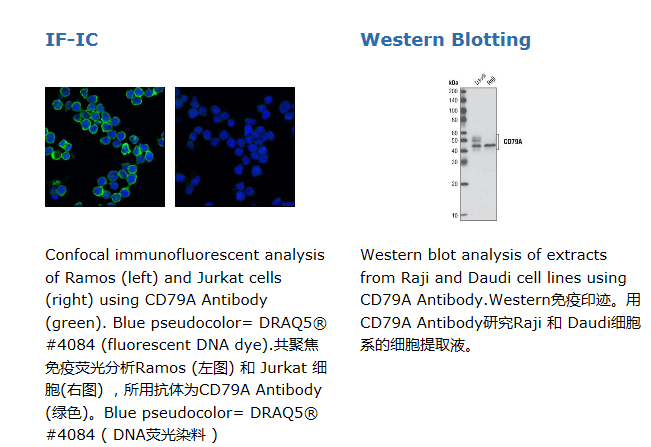
CD79A Antibody detects endogenous levels of total CD79A protein.
Source / Purification
Polyclonal antibodies are produced by immunizing animals with a synthetic peptide corresponding to residues surrounding Asn217 of human CD79A. Antibodies are purified by peptide affinity chromatography.
Background
Antigen receptors found on the surface of B-cells contain a hetrodimeric signaling component composed of CD79A and CD79B, also known as Ig α and Ig β, respectively (1,2). Presence of this receptor complex is essential for B-cell development and function (3). Together these two proteins and the associated B cell receptor initiate intracellular signaling following antigen binding (4,5). An immunoreceptor tyrosine-based activation motif (ITAM) is found in the CD79A intracellular region appears to be is important for its function (6). Antigen binding precedes formation of the CD79A and CD79B heterodimer and subsequent activation of receptor associated kinases (7). CD79A is a marker for B-lineage lymphoblastic leukemia (8); mutations in the corresponding mb-1 gene are responsible for abnormally low levels of functional B cell receptors in some cases of chronic B-cell lymphocytic leukemia (9).








 京公网安备11010802025653 版权所有:北京逸优科技有限公司