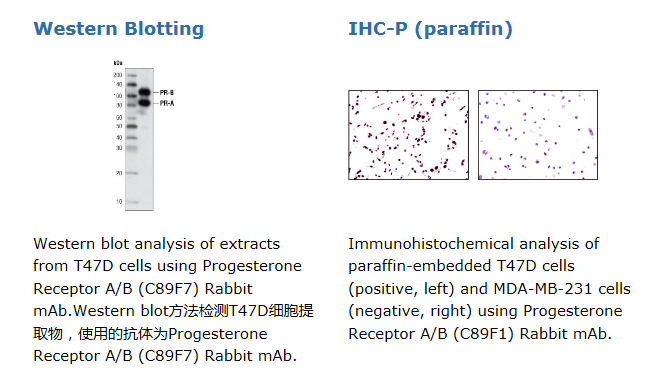




Progesterone Receptor A/B (C89F7) Rabbit mAb detects endogenous levels of total progesterone receptor A and B proteins. This antibody does not cross-react with other PR family members.
Source / Purification
Monoclonal antibody is produced by immunizing animals with a synthetic peptide corresponding to residues surrounding Tyr541 of human progesterone receptor.
Background
Human progesterone receptor (PR) is expressed as two forms: the full length PR B and the short form PR A. PR A lacks the first 164 amino acid residues of PR B (1,2). Both PR A and PR B are ligand activated but differ in their relative ability to activate target gene transcription (3,4). The activity of PR is regulated by phosphorylation; at least seven serine residues are phosphorylated in its amino-terminal domain. Three sites (Ser81, Ser102 and Ser162) are unique to full length PR B while other sites (Ser190, Ser294, Ser345 and Ser400) are shared by both isoforms (5). Phosphorylation of PR B at Ser190 (equivalent to Ser26 of PR A) is catalyzed by CDK2 (6). Mutation of Ser190 results in decreased activity of PR (7), suggesting that the phosphorylation of Ser190 may be critical to its biological function.
Storage:Supplied in 10 mM sodium HEPES (pH 7.5), 150 mM NaCl, 100 µg/ml BSA, 50% glycerol and less than 0.02% sodium azide. Store at –20°C. Do not aliquot the antibody.