p190- B RhoGAP Antibody检测内源性RhoGAP总蛋白。通过人工合成人源p190-B RhoGAP蛋白Lys296位点周围相应的多肽片段去免疫动物从而制备出多克隆抗体。通过蛋白A和多肽亲和层析纯化抗体。Rho family small GTPases包括Rho、Rac和cdc42,该家族是不同的生物进程中的关键调节因子例如细胞骨架的构建、细胞生长和分化、转录调控以及细胞粘附/运动(1,2)。这些蛋白质的活性通过GTP的结合被控制,如以GTP结合状态那它们是活性状态,而如以GDP结合状态则它们是失活状态。三种调控性蛋白通过平衡GTP/GDP结合水平控制GTPases的活性:鸟嘌呤核苷酸交换因子(GEFs)通过GDP交换成GTP从而促进活性状态;鸟嘌呤核苷酸分解抑制剂(GDIs)隔绝GDP结合形式并且可能调节它们的细胞内定位;GTPase激活蛋白 (GAPs)增加GTP水解从而促进失活状态。p190 RhoGAP家族由两个相关蛋白p190-A和p190-B组成,它们都广泛表达并且包含有一个氨基端GTPase区域和一个羧基端RhoGAP催化区域。缺少p190-B RhoGAP的小鼠显示大量的Rho激活和在转录因子CREB的激活减少(3)。这些老鼠的表型类似于CREB敲除的老鼠,伴随着细胞体积减少和胸腺和神经发育的缺失(3)。缺失p190-B的细胞也展示脂肪形成的缺陷,认为这条通路对脂肪和肌细胞形成的开关作用是至关重要的 (4)。越来越多的证据显示p190经历酪氨酸磷酸化,这激活它的GAP区域(4-6)。酪氨酸磷酸化的水平通过Src过表达被提高(5,6)。IGF-1处理通过磷酸化和p190-B RhoGAP的激活从而下调Rho,因此IGF信号的提高涉及脂肪形成(4)。
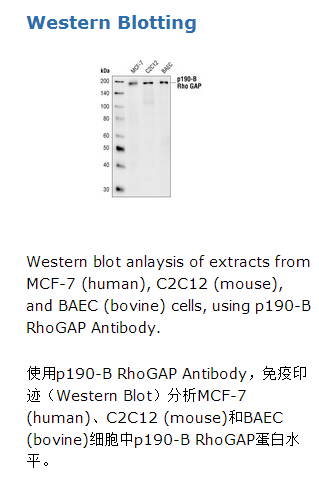
p190-B RhoGAP Antibody detects endogneous levels of total RhoGAP protein.
Source / Purification
Polyclonal antibodies are produced by immunizing animals with a synthetic peptide corresponding to a region surrounding Lys296 of human p190-B RhoGAP. Antibodies are purified by protein A and peptide affinity chromatography.
Background
The Rho family of small GTPases, including Rho, Rac and Cdc42, are key regulators of diverse biological processes such as cytoskeletal organization, cell growth and differentiation, transcriptional regulation, and cell adhesion/motility (1,2). The activities of these proteins are controlled by GTP binding such that in the GTP-bound state they are active, and in the GDP-bound state they become inactive. Three classes of regulatory proteins control the activity of the GTPases by balancing the levels of GTP/GDP binding: the guanine nucleotide exchange factors (GEFs), which promote the active state by facilitating the exchange of GDP for GTP; the guanine nucleotide dissociation inhibitors (GDIs), which sequester the GDP-bound forms and may regulate their intracellular localization; and the GTPase activating proteins (GAPs), which increase GTP hydrolysis to promote the inactive state. The p190 RhoGAP family consists of two related proteins, p190-A and p190-B, which are both widely expressed and contain an amino-terminal GTPase domain and a carboxy-terminal RhoGAP catalytic domain. Mice lacking p190-B RhoGAP show excessive Rho activation and a reduction in activation of the transcription factor CREB (3). Phenotypes of these mice are similar to those of CREB knockouts, with reduced cell size, as well as defects in thymus and neural development (3). Cells deficient in p190-B also display defective adipogenesis, suggesting this pathway is critical for the "adipogenesis-myogenesis switch." (4). There is increasing evidence that p190 undergoes tyrosine phosphorylation, which activates its GAP domain (4-6). Levels of tyrosine phosphorylation are enhanced by Src overexpression (5,6). IGF-1 treatment downregulates Rho through phosphorylation and activation of p190-B RhoGAP, thereby enhancing IGF signaling implicated in adipogenesis (4).








 京公网安备11010802025653 版权所有:北京逸优科技有限公司