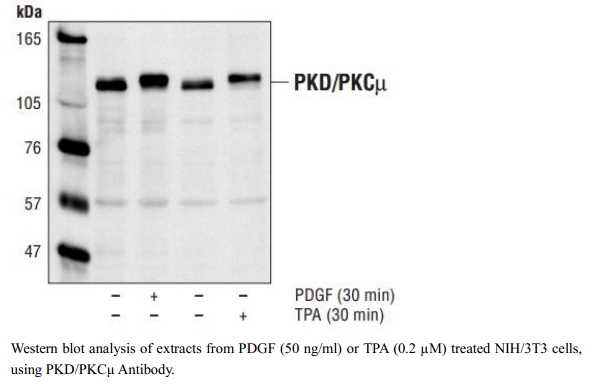
PKD/PKCmu Antibody detects endogenous levels of total PKD1/PKCmu protein. This antibody may also react with isoform PKD2, in some species.
Source / Purification
Polyclonal antibodies are produced by immunizing animals with a synthetic peptide corresponding to residues surrounding Ser916 of mouse PKD. Antibodies are purified by protein A and peptide affinity chromatography.
Background
Activation of PKC is one of the earliest events in a cascade leading to a variety of cellular responses such as secretion, gene expression, proliferation and muscle contraction (1,2). Protein kinase D (PKD), also called PKCμ, is a serine/threonine kinase whose activation is dependent on the phosphorylation of two activation loop sites, Ser744 and Ser748, via a PKC-dependent signaling pathway (3-5). In addition to the two activation loop sites, the carboxy-terminal Ser916 has been identified as an autophosphorylation site for PKD/PKCμ. Phosphorylation at Ser916 correlates with PKD/PKCμ catalytic activity (6).








 京公网安备11010802025653 版权所有:北京逸优科技有限公司