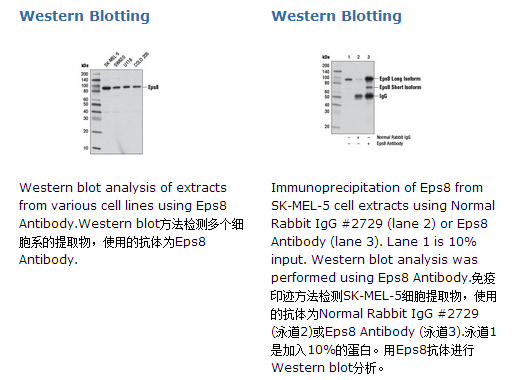
Eps8 Antibody recognizes endogenous levels of total human Eps8 protein (both p97 long isoform and p68 short isoform).
Source / Purification
Polyclonal antibodies are produced by immunizing animals with a synthetic peptide corresponding to residues near the amino terminus of human Eps8 protein. Antibodies are purified by protein A and peptide affinity chromatography.
Background
Epidermal growth factor receptor pathway substrate 8 (Eps8) is an adaptor protein and can be phosphorylated by several receptor tyrosine kinases including EGFR and Src (1,2). Eps8 is composed of an N-terminal PTB domain, followed by an SH3 domain and a C-terminal effector domain. Eps8 controls actin-based motility by capping the barbed end of actin and bundling actin subunits through its C-terminal effector domain (3,4). The C-terminal α hexlical structure of Eps8 interacts directly with actin to exert these capping and bundling functions (5). The actin capping activity requires the release of Eps8 autoinhibitory binding through SH3 domain interaction with an adaptor molecule, such as Abi-1 (6). This SH3 domain of Eps8 also binds to RN-tre to regulate the down stream Rab5-mediated endocytosis pathway (6). Eps8 functions by binding several receptor tyrosine kinases, such as EGFR or FGFR, to enhance receptor mediated mitogenic Rac signaling and Rab5 endocytosis (6,7). The effector region of Eps8 is necessary for this process. By association with Abi-1 and forming the Eps8/Abi-1/Sos-1 complex, Eps8 couples initial growth factor stimulation to actin motility and the Rac activation pathway (8,9). Eps8 has been shown to be important in the cellular function of filopodial protrusions, cell migration, microvilli formation, and focal adhesion (10-13). Research studies have demonstrated that through its involvement in actin related cellular functions, Eps8 plays a role in cancer cell growth, survival, motility, and invasiveness (14-18).








 京公网安备11010802025653 版权所有:北京逸优科技有限公司