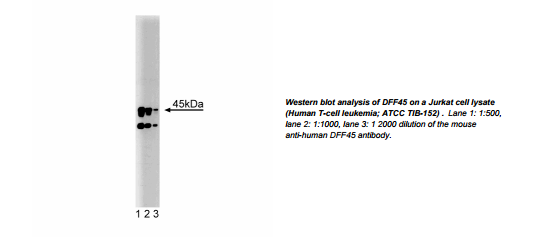
Apoptosis, a selective process of genetically programmed cell death, occurs during normal cellular differentiation and development of multicellular organisms. Apoptotic cells are characterized by loss of cell volume, plasma membrane blebbing, nuclear condensation, chromatin aggregation, and endonucleocytic degradation of DNA into nucleosomal fragments. Caspase-3 (CPP32, Yama, apopain) is the most extensively studied apoptotic protein. An apoptotic signal induces the intracellular cleavage of caspase-3 from an inactive proform to an active fragment. The active form of caspase-3 cleaves several other apoptotic proteins including DNA Fragmentation Factor (DFF). DFF is thought to be either directly or indirectly responsible for the DNA laddering that is a hallmark of apoptosis. It is a heterodimer of 40 kDa (DFF40) and 45 kDa (DFF45) subunits. Cleavage of DFF45 into three fragments is a prerequisite for DFF-mediated DNA fragmentation. Identity of the DFF fragment that mediates DNA laddering remains unclear. However, it is clear that DFF functions downstream of caspase-3 and is essential for the characteristic fragmentation of DNA during apoptosis.
原厂资料:
注意事项:
1.Since applications vary, each investigator should titrate the reagent to obtain optimal results.
2.Caution: Sodium azide yields highly toxic hydrazoic acid under acidic conditions. Dilute azide compounds in running water before discarding to avoid accumulation of potentially explosive deposits in plumbing.








 京公网安备11010802025653 版权所有:北京逸优科技有限公司