Recombinant protein derived from C-terminal region of human RelB protein.
Conjugate
Unconjugated
Form
Liquid
Concentration
0.5 mg/ml
Purification
Protein A
Storage buffer
PBS, pH 7.4
Preservative
0.1% sodium azide
Storage Conditions
-20°C
Tested Applications
Dilution *
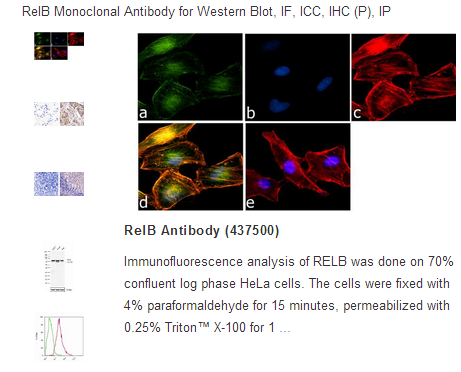
Immunocytochemistry (ICC)
1 µg/ml
Immunofluorescence (IF)
1 µg/ml
Immunohistochemistry (Paraffin) (IHC (P))
1:10-1:50
Immunoprecipitation (IP)
Assay Dependent
Western Blot (WB)
1-2 µg/ml
* Suggested working dilutions are given as a guide only. It is recommended that the user titrate the product for use in their own experiment using appropriate negative and positive controls.
Background/Target Information
NF-kB (Nuclear Factor kappa B) is a nuclear transcription factor found in all cell types and is involved in cellular responses to stimuli such as stress, cytokines, free radicals, ultraviolet irradiation, and bacterial or viral antigens. NF-kB plays a key role in regulating the immune response to infection. Consistent with this role, incorrect regulation of NF-kB has been linked to cancer, inflammatory and autoimmune diseases, septic shock, viral infection and improper immune development. There are five members in the NF-kB family: NF-kB1, NF-kB2, RelA (also named p65), RelB, and c-Rel. The RelB protein is present in the cytosol, bound to p50 or p52 and an inhibitory IkB protein, forming an inactive trimeric complex. Following cell signalling events leading to IkB degradation, Rel/NFk-B proteins are translocated to the nucleus where they regulate gene expression. The genes controlled by Rel/NF-kB family members are predominantly genes involved in the host response to infection, stress and injury. RelB mediates the regulation of genes involved in immune and inflammatory processes.
原厂资料:
注意事项:
For Research Use Only. Not for use in diagnostic procedures.








 京公网安备11010802025653 版权所有:北京逸优科技有限公司